
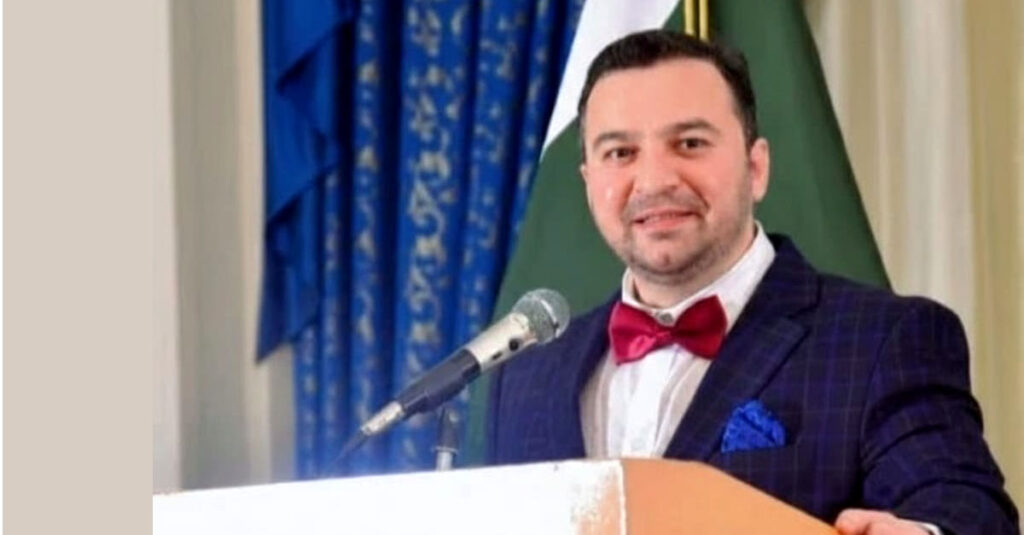
MUSCAT — When Abdul Sattar Edhi, a globally revered philanthropist and the man who started the Edhi Foundation, Pakistan’s largest welfare organisation, died in July 2016, his legacy was deeply mourned by the residents of Oman, particularly the Pakistani community.
Little did they know that Edhi’s powerful mantle was going to fall on a young Pakistani in Oman, an upcoming social worker here then. Today, nearly a decade from the passing of the universal philanthropist, the torch, at least in Oman, is passed on to Syedzada-Shaandar Ali Shah Bukhari, 43. As Shaandar himself notes here, some people in the Sultanate has begun to call him ‘Edhi’.
And it is not a title that sits lightly on Shaandar. For, the man is not one who will rest on his laurels nor is he the type to let such titles go to his head. Shaandar’s social work in Oman has already earned him other titles, such as ‘symbol of compassion’ and a social worker with ‘quiet resilience’, as the local media here puts it.
Shaandar was a born social worker and grew up “witnessing human suffering up close, quietly, without drama or applause.” While it could be said that his spiritual father figure was Edhi, his biological father was the most-revered, late Syedzada Sakhawat Ali Shah Bukhari, a legend in his own right among the expatriate population in Oman and from someone whom Shaandar learnt by “observation rather than instruction.”
Bukhari Sr taught his only son all of life’s important lessons and to never compromise on his values and most importantly, to help discreetly. Learn to help like the mythical comic book figures Phantom or Batman, the masked defenders of justice, who never revealed their true selves, his father urged. “So keep your identity concealed,” he exhorted his son. Something which Bukhari Jr follows to the hilt.
Meanwhile, an incident in his life, where he was forced to briefly role play, that of a son to a shattered mother who had lost her only child in an accident, changed Shaandar’s life drastically.
“As I grew older, that incident shaped my understanding of social work. It taught me that this is not about charity, it is about dignity. It is about standing in for someone when the world walks away. That unseen child became a symbol for me, proof that our actions today shape lives we may never meet.”
Shaandar’s work has taken him in all aspects of charity. But what he considers one of the “most emotionally demanding part of his work” is the aspect of sending expatriate prisoners back to their home countries. “Many prisoners are forgotten by time. Our role is simply to remind the world that they are still human,” he says.
Shaandar, who serves on the interim committee of the Pakistan Social Club as director welfare, was recently felicitated by the Pakistan Red Crescent Society, part of the International Red Cross and Red Crescent Movement, in recognition of his outstanding and selfless community service, particularly his efforts in assisting distressed expatriates and facilitating the repatriation of over 200 prisoners to Pakistan, which he said “was deeply humbling.”
He is also the only recipient in the entire Middle East of the American Red Cross Life Saving Award for preventing a suicide.
Excerpts:
They call you a “symbol of compassion” and a social worker with “quiet resilience.” How did it all happen? What are the factors—besides your revered father—that led you to choose this path and become the man you are today?
I never woke up one day and decided to become a social worker. This path chose me long before I understood its weight. I grew up witnessing human suffering up close quietly, without drama, without applause. My late father, Syedzada Sakhawat Ali Shah Bukhari, was a well-known and respected name among the expatriate diaspora in the Sultanate. As his only son, he kept me by his side from a very young age, and through observation rather than instruction, he taught me life’s most important lessons.
I saw him help people even when he had differences with them. If someone came to him in need, he never turned them away. He would tell me, “Never compromise on your values, but never let your ego stop you from helping anyone even if it is just showing them the way. I remember it was him and his friends who raised their voice to reduce the cargo bills of repatriation of a deceased. The authorities took action and now our national carrier takes the deceased for free and just a small amount is paid for the local documentation etc. My father used to tell me to help discreetly.” That principle stayed with me long after his passing in 2023. After his demise, life itself became my teacher.
Living among expatriates, I saw loneliness, helplessness, and fear especially when people were far from home and suddenly faced illness, imprisonment, or death. When you see a fellow human being reduced to a file number, something inside you refuses to stay silent. I believe compassion is not inherited, it is awakened. And once awakened, it does not let you rest. For me, service is not a choice, it is a responsibility. As our Holy Prophet (peace be upon him) said: “The best among you are those who are most beneficial to others.”
You had mentioned earlier in an interview that you played the role of a child you “never met,” an incident that led you to social work. Could you elaborate?
That moment changed everything. I was very young; this was sometime in the 1980s. A bus carrying expatriate staff from the Royal Navy of Oman had gone for Umrah and met with a tragic accident on the return journey. Some passengers lost their lives. One staff member’s wife suffered severe head injuries and was admitted to the Armed Forces Hospital. Her condition was not improving because she kept longing for her deceased child. Through humanitarian channels, this situation reached my father. Without telling me much, he took me to the hospital. It was the first time I was ever allowed inside a ward where children were usually stopped at the entrance. This was a special case.
When I entered, the family began clapping and calling me by the lost child’s name. I saw a woman sitting on the bed, her hair cut short, a deep scar across her scalp. When she saw me, her eyes lit up. She stood up and hugged me tightly. I was confused and scared and I wanted to say, “I am not who you think I am.” But then I saw my father behind her. He gently put a finger to his lips, smiled, and winked. Somehow, I understood that I had to stay quiet and play this role.
The love and affection of that mother are indescribable. She combed my hair, told me how much she had missed me, spoke to me as if I were her own child. I was scared, overwhelmed, and deeply moved all at once. For a moment, I even feared she might not let me go.
Later, when she fell asleep, my father took me out for a treat. He thanked me and asked, “Do you like Phantom and Batman?” I nodded eagerly. He said, “This is what they do. No one knows who they really are, but they help people quietly.”
To a child, that felt like becoming a real superhero helping someone secretly, without recognition. That continued for about a week until she was airlifted back to her homeland. I still remember her.
As I grew older, that incident shaped my understanding of social work. It taught me that this is not about charity, it is about dignity. It is about standing in for someone when the world walks away. That unseen child became a symbol for me, proof that our actions today shape lives we may never meet.
Do you still engage in your wheelchair-lending mission?
Very much so. It began with a single incident. I saw a patient discharged from hospital being pushed around on an office chair. When I asked why, the family said wheelchairs were expensive, and once the need was over, they wouldn’t know what to do with it. As expatriates, our people often hesitate to spend on temporary needs.I bought a used wheelchair from Facebook Marketplace. Then another request came. Slowly, people began donating wheelchairs. Within a year, I had nearly 500 units purchased and received by donation.
Wheelchairs restore more than mobility—they restore independence, hope, and self-respect. Today, we maintain a smaller but active pool. Some are lent temporarily, but most are given away free, especially when the patient’s condition is permanent or the family has no means. The joy of seeing someone regain dignity simply by being able to move is beyond words.
You are involved in the repatriation of expatriate prisoners. Since when, and how many have you helped? Do you work with a team?
This is one of the most emotionally demanding parts of my work. For several years now, Alhamdulillah, more than 200 prisoners of mixed races and nationalities have been assisted in returning to their homeland after completing their sentences or through humanitarian channels.
No one can do this alone. I work closely with volunteers, community elders, legal contacts, embassies, and humanitarian organisations. The process is complex verification of cases, coordination with prison authorities, medical clearance, travel documentation, and emotional counseling. Where required, we help arrange legal guidance, medical attention including minor surgeries, basic necessities like reading glasses, and family coordination. Many prisoners are forgotten by time. Our role is simply to remind the world that they are still human.
All of this requires funds. How do you raise them, and is it ever enough?
I do not collect funds, as it is neither simple nor permitted under local laws. In rare cases where support is required, it comes purely through trust. Ordinary people, drivers, shopkeepers, labourers contribute quietly. Some give money, others give time, transport, or contacts.
Transparency is essential. I never ask without a clear purpose, and I never promise what I cannot deliver. Often, I simply post a request in local WhatsApp groups with a travel itinerary, and someone purchases the ticket directly.
Is it ever enough? No. But when intentions are sincere, doors open at the right moment. Generosity multiplies when shared honestly.
Your father was the General Secretary of the Pakistan Social Club for a long stretch. Are you also involved, and does the PSC serve Pakistanis in distress?
Yes, the Pakistan Social Club has long been a pillar of support for resident and non-resident Pakistanis, particularly in cases involving legal trouble, imprisonment, medical emergencies, and death. Prior to its inception, this role was played by the Pakistan Cultural Centre Oman (PCCO). My late father served as General Secretary for four unopposed terms. Today, I serve on the Interim Committee appointed by the Embassy of Pakistan, the Sheikh of the Pakistani Community in Oman, and the Ministry of Social Development, in the capacity of Director Welfare. However, I was a welfare facilitator long before I held any official title, some people call me Edhi of Oman (Edhi was the most famous social worker from Pakistan). Institutions matter but people give them life.
There is a risk factor in such work. Have you ever felt affected or vulnerable?
Absolutely. There is a thin line between helping and being misunderstood. This work involves legal sensitivities, intense emotions, and desperate situations. It is often a thankless job. I have faced stress, misjudgement, and personal loss.
But fear cannot be allowed to overpower compassion. I remain careful, transparent, and law abiding. When intentions are clean, even hardships become lessons.
What challenges do you face, and does social work affect your family life?
The greatest challenge is emotional fatigue: carrying stories of pain while appearing strong. Social work demands time, and yes, family life is affected. I owe immense gratitude to my family for their patience and silent sacrifices. They understand that this work is not separate from who I am—it is who I am.
Give us a glimpse of a day in your life.
There is no routine. A day may begin with an early-morning distress call. I listen, calm the person, note the issue, and then head to my office. Most coordination happens through WhatsApp calls from prisons, hospitals, or families dealing with death cases. Documentation often continues late into the night. Some days are hopeful; others are heavy. But every day ends with gratitude because I was able to help, even if only a little.
Tell us about your recent felicitation by the Pakistan Red Crescent Society and other awards. Which one is closest to your heart?
The felicitation by the Pakistan Red Crescent Society, part of the International Red Cross Movement, was deeply humbling. It reaffirmed that humanitarian work transcends borders and recognition.
I am also the only recipient in the entire Middle East of the American Red Cross Life Saving Award for preventing a suicide. It is the world’s second-oldest life-saving award and very close to my heart and my request to the authorities is to assign a counselling help line dedicated to suicide prevention.
That said, the most meaningful recognition is not framed on a wall, it is the silent prayer of a mother, the relieved smile of a freed prisoner, and the dignity restored to a forgotten soul.
Looking ahead, what are your future plans and dreams?
There is still a long road ahead. My goal is to institutionalise this work in the Sultanate of Oman, to build a system so that the help does not depend on one individual. I dream of a structured humanitarian support network for expatriates, ensuring no one feels abandoned abroad. That is why I share my work publicly to inspire and train the youth to take over after me. If my journey encourages even one person to help without expecting anything in return, then my purpose is fulfilled.
Any final thoughts?
You don’t need wealth, power, or a title to change lives. You only need empathy and the courage to act. Service is not a grand gesture; it is a daily choice. And when you choose humanity, humanity always finds its way back to you.

0 Comments