
Once when UNICEF officials visited a school, they found a child with severe disabilities drooling in the classroom. The other children in the class were not used to seeing this and began to stare. A definite unease was spreading in the classroom, so the officials decided to do something about it. But, after a while, it was the students of the class who took matters into their own hands.
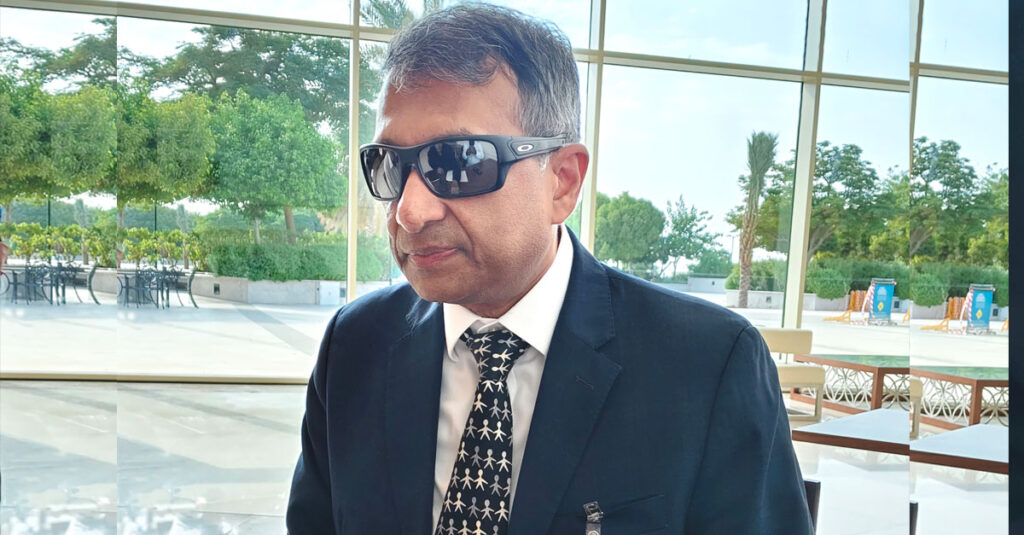
Gopal Mitra, Global Lead on Disability and Development at UNICEF, who was recently in Oman on visit, narrated this tale about how a young disabled child in a classroom was taken care of by his classmates.
Mitra noted how he began to work on the child trying to bring about a change. The student’s mother also chipped in her bit. But the best part was that in a matter of months, the rest of the students in his class took upon this responsibility and said that now they would take care of their “brother”. The changed attitude of the other students was an eyeopener.
“Yes, kids have this amazing ability,” Mitra told Black & White, as he recounted this heart-warming tale. The shift in the attitude of the children from shock and surprise to love and empathy was inspirational, he says. “The students’ parents also got inspired realising that there was a very humane side in their children.
“And the result: a child was brought to the school and the child became the school!” Mitra said, recollecting the inspirational incident.
Mitra, who has over 20 years of experience leading disability inclusion work around the world, was detailing UNICEF’s past visit to a school in a foreign country when he cited this moving anecdote. During his visit to the Sultanate, he spoke at the Second Oman Childhood Conference, organised by the Children First Association to highlight the global efforts to advance the rights of children with disabilities. The conference was held under the patronage of Her Highness Dr Mona bint Fahd Al Said. Mitra said his visit offered a great chance to explore how inclusion and accessibility are being strengthened across different sectors – and how this connects to Oman’s ongoing efforts to ensure every child has the opportunity to thrive.
EXCERPTS:
Could you give us a brief on UNICEF’s efforts to advance the rights of children with disabilities?
If you see the mission statement of UNICEF, it says that the most disadvantaged children – those who live in chronic poverty; are impacted by wars and conflict; and those with disabilities — will always get priority. So, that says it all. The UNICEF works around the globe on the rights of children and ensures that children are protected from violence, neglect and abuse.
Along this journey, UNICEF makes an extra effort to ensure that the most disadvantaged children are not left behind. And over the years, especially the last 10 years, we have seen the organisation going that extra mile to ensure that when we are talking about education, children with disabilities are not left out.
Inclusive education for children with disabilities is a pillar of our education strategy. We know that children with disabilities are more likely to experience violence. Especially those with intellectual disabilities. So, we have programmes which cater to that.
What our data tells us is that households with children with disabilities often have extra costs. So, when we are developing our cash transfers, cash benefits and social protection, we ensure that children with disabilities and their families are always factored in. And for the last four or five years, we have had an annual global reach of 2.5 million children with disabilities.
Last year, we reached 5.2 million children with disabilities. So, we were able to double the reach. But having said that, we must also humbly point out that there are 240 million children with disabilities in the world. So, although we are doing a lot, the truth is that there is so much more to do.
Oman possesses a range of specialised and mainstream services for children with disabilities; it was the first country in the region to “advocate for the integration of children with special educational needs in the mainstream education”. But is there room for more?
I am visiting Oman for the first time. But, in the first few days itself what I saw when I visited the Early Childhood Intervention Centre was very heartwarming.
I was really encouraged to see what the children were getting. It is high quality, both in terms of human resources that were there, the specialists, the occupational therapists, the physiotherapists, the speech therapists, as well as the equipment. And even though I am blind, for someone like me who has been to many countries, I got a positive vibe of the place and I really felt very happy.
We also spoke to the ministries of education and social development, and I really see their commitment to do better. So if you are asking me whether there is an opportunity to do more, then what I have got from the ministers and the leadership I met here is that they all want to do more. There is a recognition that though there are things being done, they still want to do more, which I think is excellent.
According to you, how difficult a task is it to integrate children with special needs into mainstream education or in other sectors? What do you think of Oman’s efforts in this arena?
If I pretend that it is easy, I will be lying. Because if it was easy, it would already have been done. But what we know is that it is possible, and we have a better idea of how to do it.
Stigma, social norms, negative attitudes, are the root cause of exclusion of the children with disabilities. We have worked in over 100 countries on social behavioural change in programming.
What we realise – and even more in disabilities – is that the barriers are not in the buildings or on the roads. The biggest barriers are in our minds.
And we have seen, from Peru to Uganda to Bulgaria to Georgia, that if you take a very scientific, evidence-driven approach, and a combination of community engagement, training of frontline workers, public campaigns, and overall communication, it is possible to break this stigma.
I will give you an example. In Georgia, there was a campaign called See Every Colour. We did knowledge attitude practice studies before and after the campaign.
And what we found out is that in two years, public stigma on disability was reduced from 42 to 28 percent. So, it is possible to do that.
When a child with a disability is born, or the family realises that their child has a developmental delay or disability, the basic emotion is sadness and this is followed by fear and helplessness.
All the work that we do is to change that feeling from sorrow, fear, and helplessness to courage, support, and hope. And it’s possible. It is possible to shift from a vicious cycle of a downward spiral to a virtuous upward spiral.
Many a time, access to key rehabilitation and education services for children with disabilities remain a challenge because most are only available in major cities. Your comments.
In UNICEF, we are very conscious whenever we approach this issue. So when I was visiting the Early Childhood Intervention Centre and the Rehabilitation Centre, one of my questions was: is this service only in Muscat? And I was surprised to learn that the government has 75 rehabilitation centres, another 50 or 52 private and civil societies.
In total, there are about 125 plus centres. They are all spread out over the country. And in addition to that, there are mobile vans. So, the reach is very much there.
You have over 20 years of experience leading disability inclusion work, is the situation getting better or worse?
It is definitely getting better. The advent of technology, social media and all of that has helped. Let me put it like this: Twenty years back, how many buildings had ramps? Today, most of the malls are equipped with ramps. The building plans include and consider disability. So, this shows that progress has been made. Today if you go to a school, you will find some children with disabilities. Twenty years back, you would not see that.
Offices and workplaces have some people with disabilities working there. Before that there was none. So we have made progress, there is no doubt about that.
However, the scope of the issue is huge. We are talking about 1.3 billion people with disabilities globally, which is around 15 to 16 percent of the population. And secondly, we started from a very low base. So on a scale of 0 to 10, we started at 1.5. And that is what keeps me awake. After so much work, and even when you have made 200 percent progress, on the scale it is only between 3.5 and 4. The growth is there, but the volume is high. The starting base is low. And the result is that you don’t still see as many people with disabilities as you should have seen when you go out.
You have gone through your life with a disability. What was the biggest challenge you had over these years?
The biggest challenge is the attitude of people.
When they hear about disability, their expectations become lower. They view you as a person with a disability, and wonder how much will you be able to do? So you are caught in a cycle of low expectation and low delivery. That is the expectation of society for you. The biggest challenges are not in these buildings or in the inaccessible roads, it is in the minds of people.
Of course, we see that changing. I think technology is a game changer for persons with disabilities.
Take me for example: I am a blind person living in New York. Imagine myself crossing a busy road. Normally, I would have to listen intently to the traffic and make my movements accordingly.
But, now I have an app on my phone. I just point the camera at the signal and it tells me when the sign has turned from green to red and more. It is an AI-based app. If I have a picture, I can just share it with another app using AI. It describes to me the features of the picture and it is quite accurate. Technology is a game changer.
So, I am very hopeful. I hope the world turns better.

0 Comments