
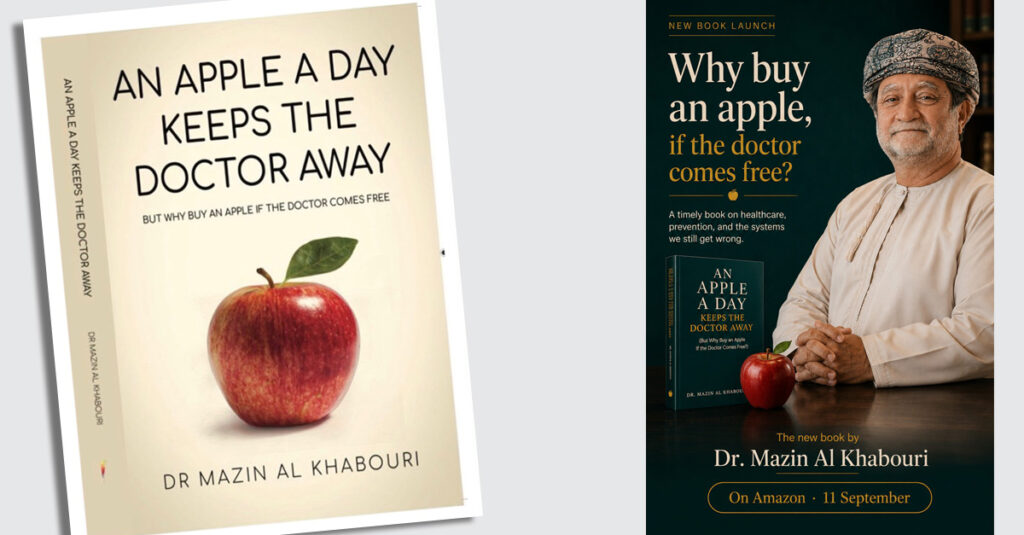
He has spent four decades inside Oman’s health system – as a surgeon, a hospital director and a national regulator. Therefore, Dr Mazin Al Khabouri is best positioned to ask the question free healthcare cannot keep avoiding: Why buy an apple, if the doctor comes free? Why invest in prevention when treatment is free?
This is the thought-provoking question which lies at the heart of Dr Khabouri’s book, which was launched recently: An Apple a Day Keeps the Doctor Away: But Why Buy an Apple If the Doctor Comes Free?
With this book he examines the paradox facing modern healthcare systems – particularly in the GCC and Oman – “where easy access to care can unintentionally discourage healthy living”. He challenges conventional thinking on “prevention versus cure, asking how societies can foster responsibility for health while maintaining equitable access to care”. But if Dr Khabouri has questions, he also has answers. If there are problems, there are also solutions:
Solution within the problem
“The solution is within the problem,” he says, adding: “The problem is that people do not see the value of their healthcare. So let us make that value visible, without taking the care away. “I am not advocating an end to free healthcare for Omanis. Its founding principles of universal access and care free at the point of need are a national achievement worth protecting. The answer is to protect access while discouraging waste and rewarding prevention,” Dr Khabouri says and also colourfully frames it in his introduction: “Nobody overeats à la carte. Everybody overeats at the buffet. Now think about healthcare.” He also musters up three key points — make the cost visible, strong primary care as the front door, reward prevention — and explains them in his conversation with the BLACK & WHITE.
A call to action
In short, Dr Khabouri’s answer to the core question, “Why buy the apple” is a call to action: healthcare systems must be re-engineered to encourage wellness so they do not collapse under the weight of preventable chronic diseases.
EXCERPTS:
Four decades in medicine: when did you realise that ‘free care’ was changing how patients take responsibility for their health?
It was not a single moment. It crept up on me, clinic by clinic, over the years. As a young doctor you are busy treating the patient in front of you, and you don’t notice the pattern. Later, when I moved into leadership roles at the Ministry of Health (as advisor to the minister, then director general of private health establishments, and then of Khoula Hospital), I began to see the whole population rather than one patient at a time, and the pattern became plain to see. The penny finally dropped through a saying. One of my teachers in Scotland used to quote his father, a general practitioner: “An apple a day keeps the doctor away”, and then complete it himself: “…but why buy an apple if the doctor comes free?” That sums up the attitude I had been seeing for decades: patients who would not change their diet or walk thirty minutes a day, but who expected a pill to undo the damage.
It’s human nature: a safety net makes us bolder. A child will happily jump from a height into a parent’s raised arms, knowing he or she will be caught. Road-safety researchers call this “risk compensation”. In a study in the Netherlands, drivers who did not normally wear seat belts drove faster and followed the car in front more closely once they buckled up.1 In Norway, Oslo taxis fitted with anti-lock brakes were driven closer to the car ahead than taxis without them.2 Free healthcare can work the same way: because the safety net is there, we take more chances with our health.
Does something that is free lose its value? Does free treatment make people complacent about their own vulnerability, and does it affect how they value themselves?
Human nature is the same everywhere. As the influential American writer and political activist, Thomas Paine, put it, “What we obtain too cheap, we esteem too lightly.” In the book I use the analogy of a buffet. At a buffet, people pile up their plates because it feels free, even though they paid at the door. At an à la carte restaurant, they look at the price of every dish. Healthcare free at the point of delivery is a buffet. It is not really free; the cost is hidden in the state budget, in our oil and gas revenue, in what is not spent on schools or roads. Because the patient never sees the bill, the system and the doctor’s time are undervalued, and so, quietly, is one’s own health.
Economists call this ‘moral hazard’: when someone else carries the risk, we take more risks ourselves. It is not that people deliberately neglect themselves. The safety net is so reliable that they forget they are walking on a tightrope. Diabetes, high blood pressure and obesity give no warning for years, and by the time they announce themselves the damage is done. The deeper point is about self-worth. Your body is a gift from Allah, and it is a remarkable machine: a heart that pumps without rest for ninety years or more, and kidneys and a liver that clean your blood 24 hours a day. Free treatment should never make us forget that we are the first custodians of that gift. The doctor comes second.
Has free treatment brought about the rise in lifestyle diseases such as diabetes and hypertension in the GCC and Oman?
I would be careful not to blame free healthcare alone. That would be too simple, and unfair to a system that has served Oman superbly. The main drivers are what we call the social determinants of health. Within one or two generations our region moved from an active life of farming, fishing and walking to air-conditioned cars, offices and fast food. Add a hot climate that discourages outdoor exercise, and portion sizes that have grown with our prosperity.
The United States, where people pay heavily for healthcare, has some of the worst obesity rates in the world, so payment by itself is no protection. A large part of this change is on our plates: ultra-processed food. These are industrial products made mostly from refined starch, sugar, oils and additives, with long lists of ingredients you would never find in your mother’s kitchen: fizzy and energy drinks, packaged snacks, sweetened cereals, instant noodles and processed meats. They are cheap, convenient, heavily advertised and designed to be eaten quickly and in excess. In a carefully controlled study at the US National Institutes of Health, volunteers given an ultra-processed diet ate about 500 more calories a day than on an unprocessed diet, and gained weight within two weeks.3 A review of studies covering almost 10 million people linked high consumption to 32 harmful outcomes, including around a 50 percent higher risk of death from cardiovascular disease and a higher risk of type 2 diabetes.4 Our grandparents ate dates, fish, rice and laban; many of our grandchildren are growing up on crisps and energy drinks.
What free care does is remove one of the brakes. When there is no personal cost to falling ill, there is one fewer reason to stay well. So free care is not the cause of the epidemic, but it can make it easier to ignore the warning signs. In Cairo I once saw a fast-food outlet called “Heart Attack”. Can you imagine? That is the cultural tide we are swimming against.
How can Oman encourage the public to take their health seriously? In the clinic, how do you move a patient from “free prescription and quick fix” to lifestyle change?
In the clinic, it starts with time and honesty. A two-minute consultation that ends with a prescription teaches the patient that health comes in a box. I prefer to:
- Explain, not just prescribe. If a cold is viral, I say so and explain why an antibiotic will do harm, not good.
- Write the lifestyle prescription down. “Walk 30 minutes after Maghrib, five days a week” carries more weight when written like a prescription.
- Involve the family. In Oman the family decides what is cooked and eaten. Changing one person’s diet rarely works; changing the household’s does.
- Measure and follow up. Weight, blood pressure and blood sugar at every visit, so patients see the results of their own effort.
At national level, Oman has excellent foundations. Our primary healthcare and public health systems are among the best in the world, and WHO benchmarks show it. But our health messaging is still stuck in the era of wall posters and pamphlets. We should use social media the way the big brands do: be interactive, listen to people, and above all measure whether attitudes and behaviour actually change, not just how many messages we sent.
You have pointed to a problem. Is there a solution, or is the solution within the problem? How can Oman maintain free care for those who need it while giving enough incentive for prevention?
In a sense, the solution is within the problem. The problem is that people do not see the value of their healthcare. So let us make that value visible, without taking the care away. I am not advocating an end to free healthcare for Omanis. Its founding principles of universal access and care free at the point of need are a national achievement worth protecting. The answer is to protect access while discouraging waste and rewarding prevention:
- Make the cost visible. A simple statement after a visit or an operation, e.g. “The cost of your care today was RO X”, reminds people that nothing is truly free.
- Strong primary care as the front door, with clear referral pathways and digital or telephone triage, so people are guided to the right level of care.
- Reward prevention. Within insurance schemes such as Dhamani, lower premiums or other incentives for people who take part in screening and wellness programmes.
Is Oman still searching? Every country is. Oman Vision 2040 and Health Vision 2050, and the Dhamani platform, show that we are thinking seriously about sustainability. In the book I argue for keeping tax-funded care for Omani nationals while using Dhamani and public–private partnerships to bring efficiency and capacity. Prevention is affordable. Will the powers that be realise that shifting from expensive cure to affordable prevention can ease the financial strain? I believe they do realise it. The difficulty is not understanding, it is timing. The cost of prevention is paid today, and the savings arrive in 10 or 20 years, often beyond a single planning cycle. I call this “policy myopia” in the book. Prevention also lacks drama: nobody holds a press conference for the heart attack that never happened.
The evidence is overwhelming:
- In the United States, the Diabetes Prevention Programme cut new cases of type 2 diabetes by 58 percent in high-risk adults through lifestyle change alone, returning about $2.43 for every $1 spent.
- Finland’s North Karelia project reduced cardiovascular deaths by around 75 percent over 40 years through community action on diet and smoking.
- The measles vaccine returns about $58 for every $1 invested.
Prevention is affordable, but it is not free. It needs upfront investment, patience and a way to measure the returns. If we measure prevention the way we measure hospital activity, the case makes itself.
What is the one policy move required to bring about such a change?
If I may choose only one: make prevention pay for itself, and show the results.
Oman has already taken a brave step with the excise tax on tobacco and sugary drinks. The next move is to ring-fence that revenue for prevention, through school health, community wellness programmes and screening, and to publish every year what it achieved: kilograms lost, blood pressures controlled, diabetes cases avoided. The goal is to turn a tax into a visible investment in our people’s health. Behind that sits a wider principle, Health in All Policies. The ministry of health does not have a monopoly on health. Town planners who build pavements and shaded walkways, education officials who design school meals, and the food industry all have a stake. One move, many hands.
What advice would you give to young Omani doctors facing this same problem?
I trained many young doctors over the years, from medical students as clinical tutor, as chair of the ENT residency programme and through the Arab Board, and my advice is this:
* Your prescription pad is not your only tool. Your words, your time and your example are just as powerful.
* Have the courage to say no to an unnecessary antibiotic, scan or referral, and the patience to explain why. Patients respect honesty more than we think.
* See the population behind the patient. Every patient you see represents hundreds more in the community. Learn some public health and health economics. It will make you a better clinician.
* Be a role model. Patients notice whether their doctor is fit, does not smoke and practises what he or she preaches.
* Measure what you do. Audit your outcomes. What gets measured gets improved.
Medicine is not just a job. It is a service to our people, and prevention is the highest form of that service.
Shouldn’t schools teach students the value of an apple over free healthcare?
Absolutely. Habits formed at seven last until seventy. If we want to change a mindset, school is where we must start.
Health literacy in the curriculum: how the body works, what food does to it, and why sleep and exercise matter, taught in a practical, engaging way. Healthy school canteens: no sugary drinks or ultra-processed snacks sold at school. Children cannot learn about apples while buying crisps at break time. Daily physical activity: with shaded and indoor spaces suitable for our climate.
A lesson on value: let children learn what a hospital stay, an operation or a dialysis session really feels like, through hospital visits and by talking to patients. Once they understand where an unhealthy lifestyle leads, and the value of good health, they will respect their bodies and care for them.
Children are also wonderful ambassadors. They come home and tell their parents to wear a seatbelt or stop smoking, and the parents listen. If we teach our children the value of an apple, they will teach the rest of us.
References:
1. Janssen, W. (1994) ‘Seat-belt wearing and driving behavior: An instrumented-vehicle study’, Accident Analysis & Prevention, 26(2), 249–261.
2. Sagberg, F., Fosser, S. and Sætermo, I.-A. F. (1997) ‘An investigation of behavioural adaptation to airbags and antilock brakes among taxi drivers’, Accident Analysis & Prevention, 29(3), 293–302.
3. Hall, K. D. et al. (2019) ‘Ultra-processed diets cause excess calorie intake and weight gain: An inpatient randomized controlled trial of ad libitum food intake’, Cell Metabolism, 30(1), 67–77.
4. Lane, M. M. et al. (2024) ‘Ultra-processed food exposure and adverse health outcomes: Umbrella review of epidemiological meta-analyses’, BMJ, 384, e077310.
(Dr Mazin Jawad Al Khabouri is a senior consultant ENT surgeon at Badr Al Samaa Royal Hospital, a former director general of private health establishments at Oman’s ministry of health (MoH), and an advisor for clinical affairs to the MoH)

0 Comments