
MUSCAT — The Ministry of Labour, represented by the Directorate General of Vocational Colleges, announced the opening of registration for 1,195 training programs for the academic year 2026/2027.
These programs are distributed across seven branches of vocational colleges in the wilayats of A’Seeb, Saham, Sur, Ibri, Shinas, Al Buraimi, and Salalah, running until the 19th of this month.
Dr. Shafiq Darwish Al Abri, Director of the Department of Student Affairs and Vocational Partnerships, emphasized that opening registration for vocational efficiency programs comes within the Ministry of Labour’s orientation toward providing vocational training pathways that empower job seekers holding Tenth and Eleventh Grade certificates to acquire practical and specialized skills, and enhance their readiness to transition into the labour market according to a clear and progressive training path.
He explained that vocational efficiency programs represent an educational and training opportunity combining applied knowledge with professional practice, by providing a diverse range of technical and vocational specializations covering multiple fields, thereby offering trainees broader options suited to their inclinations and abilities, and enabling them to build a professional foundation that can be developed and advanced through training stages.
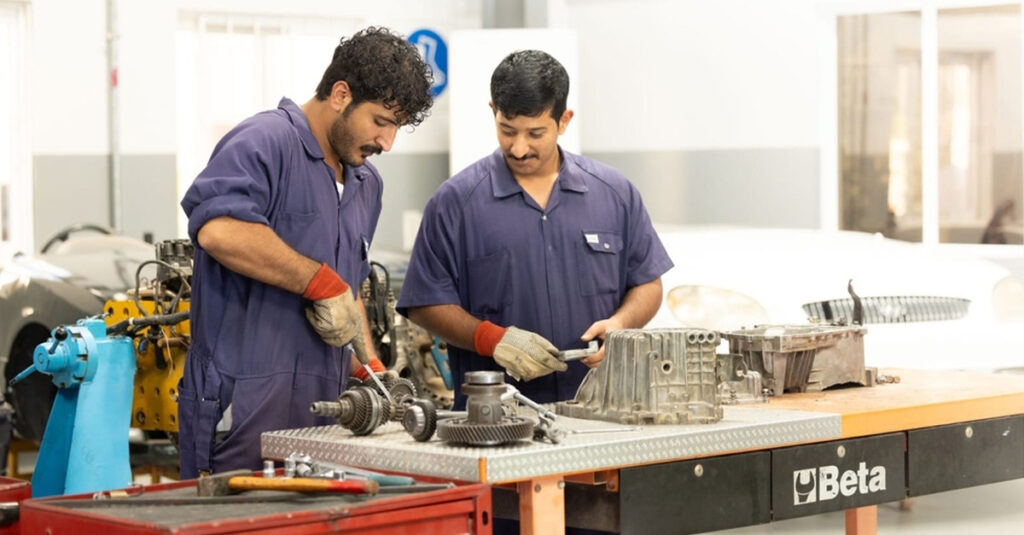
He noted that the list of programs reflects diversity in vocational fields, including welding and metal fabrication, maintenance and repair of refrigeration and air conditioning units, repair and maintenance of light vehicles, furniture carpentry, operational mechanics, painting and decoration, auto body repair and painting, electrical and water plumbing extensions, maintenance of electronic devices, food manufacturing techniques, and cosmetology and hairdressing for females, thereby providing multiple training paths for job seekers wishing to acquire specialized vocational skills.
He added that capacity distribution indicators show a remarkable focus on a number of technical specializations, with five main specializations accounting for about 74.6 percent of the total capacity. Heading the list is welding and metal fabrication with a capacity of 260 trainees, followed by refrigeration and air conditioning maintenance and repair with 202 trainees, light vehicle repair and maintenance with 155 trainees, furniture carpentry with 145 trainees, and operational mechanics with 130 trainees.
He pointed out that the A’Seeb branch leads the branches in terms of capacity with 270 trainees, reflecting the volume and diversity of programs available there, while the remaining capacity is distributed across other vocational branches according to the nature of programs and specializations offered by each college.
He stated that the core value of vocational efficiency programs lies in imparting basic skills to trainees and offering them a progressive training path, as trainees receive the Vocational Efficiency Certificate (1) at a limited-skill level in the first academic year, and can then proceed to the second academic year to obtain the Vocational Efficiency Certificate (2) at a skilled level, alongside receiving a monthly financial allowance throughout the training period.
He called on job seekers meeting the admission requirements to take advantage of the specified registration period, familiarize themselves with the available programs, and select the specialization aligning with their capabilities and interests, emphasizing that investing in vocational skills represents one of the key pathways to empowering youth and enhancing their readiness for future career opportunities.

0 Comments