
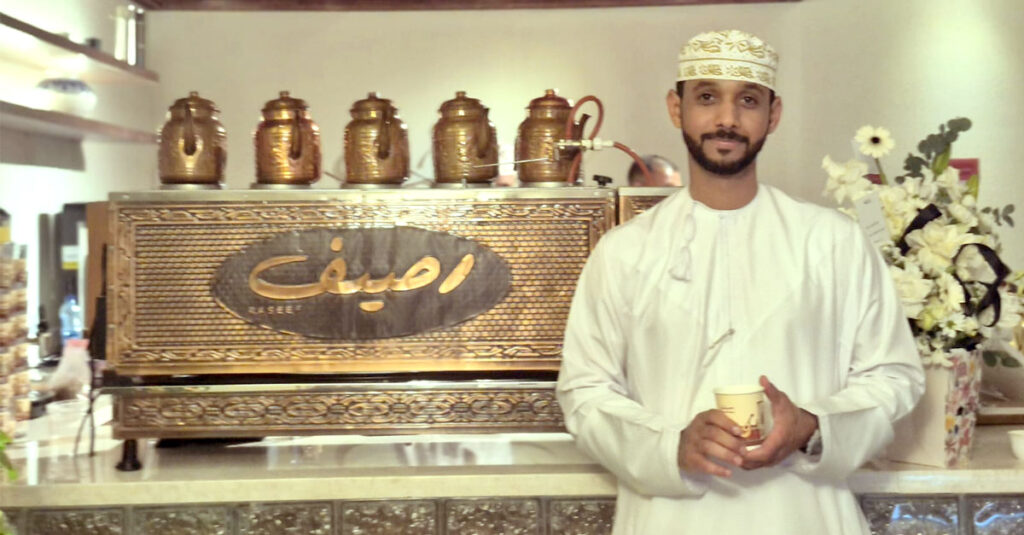
What happens when tourists taste Omani kahwa for the first time? They get a flavour shock. It takes them some time to get to the mix of unsweetened, herbal earthiness followed by the warm, aromatic burst of cardamom, saffron and rose water. But, when AMJAD NASSER AL JADIDI, 34, a young and energetic Omani entrepreneur and an operational specialist at Rakiza Fund, brought this homemade brew to his Japanese teacher and students, during his early stint in Japan, they reacted differently. “They didn’t respond immediately. My teacher said he and the students would give me the feedback only next week. The Japanese are very polite, so some of them later said it was nice. However, my teacher confessed that he didn’t like the kahwa’s taste at the start.
“But then later, the teacher realised that what he tasted was not just coffee. He had actually tasted my culture; my family. “He told me, ‘This was Amjad’s heritage. His identity. This was Amjad’s country and its people and I was tasting all of it in one sip of his kahwa! So even if it tastes different for me, I realise its value and I understand that you brought it for us because it is the most important drink for you.’”
Deep connection with Japan
Amjad Al Jadidi was relating this story as one among many examples of the depth in thinking of the Japanese and offered a clear vision of the country’s deep-rooted culture, which he had imbibed over his eight years there. Amjad was entertaining some journalists at the pre-launch of the beachfront branch – Qurum, Beach One – of his business enterprise, Raseef, a specialty tea brand, when he spoke about his deep connection with Japan and its people. Amidst an array of goodies, especially the exciting new items of an exclusive menu upgrade tailored for leisurely socialising at Raseef, Amjad gave an insight into his deep connection with Japan and how his experiences there transformed his life.
Never shallow, very deep
“The Japanese are never shallow – they are very deep!” Amjad emphasised. And he was speaking from experiences, such as the one he narrated. Studying in Japan as an Omani scholar at the Tokai University and the cultural immersion shaped Amjad, who fostered fluency in Japanese and attained deep familiarity with Japanese corporate practices through training at institutions like Mitsubishi Corporation (*). “It was a short, sweet stint with this mega corporation but at the start I was not sure whether I was acquiring much knowledge. But, everyone at Mitsubishi was super nice to me. And when I expressed my feelings about what I would take away from the Mitsubishi experience, they said something that opened my eyes and gave me yet another insight into the depth of the Japanese philosophy.
“They said, ‘look Amjad, we are treating you as a seed. After many years, you will be in a position and you will still remember us. And then I understood what they were trying to say: I was a seed and the fruit will come later. There was no need to rush the results. This way, they bury the seeds and the results will be seen not in the near future, but maybe several decades later. The seeds of love, support, generosity will fruition in time. Not immediately, but ultimately. This is yet another great philosophy that I learnt from the Japanese.”
Such immersive educational and operational background enabled him to successfully direct complex international project execution such as the Oman Pavilion at Expo 2025, sharing Oman’s natural landscapes and traditions, like the aflaj irrigation systems, with global audiences.
The six-months long Expo witnessed more than 1.4 million visitors and it was a major experience for Amjad. “I had to manage more than 60 Japanese staff, train them and teach them about Oman,” Amjad said, noting that many Japanese who had no clue about Oman began to realise that this was the hidden gem in the Gulf. “So many of them realised that Oman was a country that they could get attuned to, thanks to the fact that the Sultanate is a quiet and peaceful nation, with a rich history. The Japanese who visit Oman realise that it is a real safe country. Plus, there are a lot of similarities between us and the Japanese.”
Amjad, who turned 34 recently, was 17 when he went to Japan and 26 when he returned. In this span of years, his success is that he integrated the best of Japan and Oman into himself. He has also blended Omani hospitality with structured Japanese cooperative habits. “I have imbibed the best of Japan so much so I think my character, is more like Japanese. The country was inspiring and so were its people. I always looked up to my Japanese teachers – they were inspiring me with their lives, and the best part was that there is an ingrained culture of helping others,” Amjad said, highlighting how he integrated Japanese mentorship values like the senpai-kohai (senior-junior) dynamic into his professional teamwork and leadership approach. The senpai-kohai model delves in mutual respect where seniors guide newcomers, and this mirrors how Amjad manages operations and shares his success story experiences with younger professionals like his teammates at Raseef and various other ventures he has started. “I am happy and grateful to be able to help young Omanis in these ventures. They, in turn, support their families and I am happy that I can contribute to that.
“I always want to open doors to people, empower them. I was empowered by many and I want to pass this on. It is our duty to teach the next generation and thereby pass the torch on. And I owe all of this to what I have learnt to the Japanese. I would not be here, talking or being like this if not for my experiences in Japan.”
Raseef – cosy social ambience
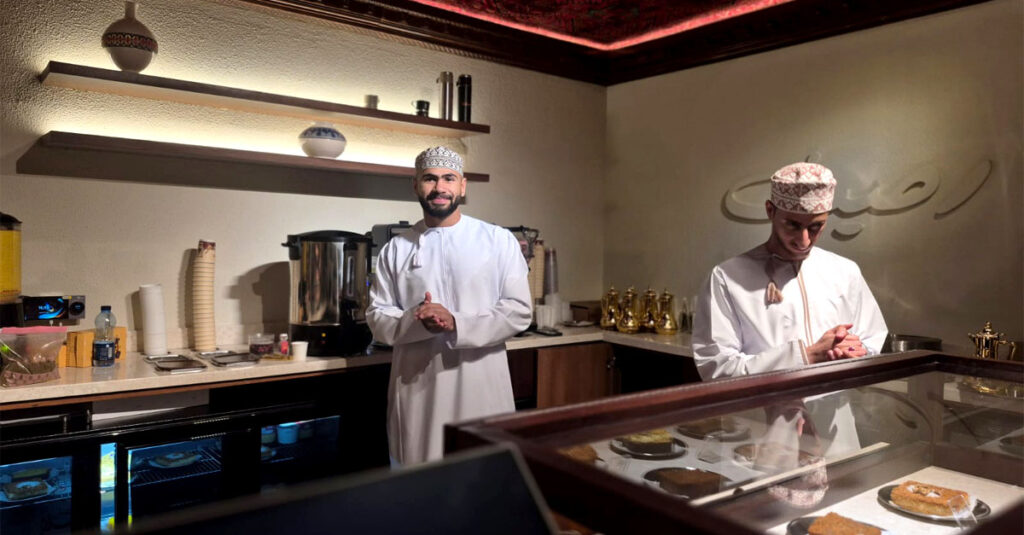
Amjad also briefly charted the success story of Raseef, which he noted was a growing Omani specialty tea brand, known for its specialised brewed teas, local Omani flavours like Omani Loomi and Rose milk. The brand has expanded to this current third branch in Qurum (Beach One) and at their launch they inaugurated a new menu. Amjad said that with Raseef, he wanted to focus on creating a cozy social ambience around the local tradition of tea drinking and the outlets welcomed everyone, the young and the old.
The Bahla experience
Amjad originally hails from Bahla. Right from a young age, he felt that there was a need to hoist Bahla’s profile to a much-elevated tourism centre. “I used to get envious when tourists head to other popular spots and not Bahla.” Then an opportunity presented itself to do his bit to Bahla where when he loaned some funds to a friend who wanted to start a restaurant in Bahla souq, which has a history dating back several hundred years old. A visit to the souq threw him into the specialty coffee business. “I first picked a small shop but then ended up with 12 outlets there. We innovated, in the sense, we made each room special with creative designs that catered to different tastes and palates. So, each one had its own unique atmosphere. It was a great hit and we had clients coming from Sohar and Shinas.” He went on to start another branch too before getting out of that arena.
Future in manufacturing
Amjad is a restless soul and difficult to stay idle. Soon enough, armed with a general idea from his experience in Saudi Arabia, he went on to launch the Raseef tea concepts in Oman. “Now, we have three branches and two more are coming soon,” he announced.
Amjad also sees a future in manufacturing and that is a dream he is going to chase later on. “Maybe because of my Japanese background, I always want to own a factory. I want to create a product that represents Oman. I feel that there is a dearth of such products in Oman. Of course, we have halwa and dates, but we still need something, some snacks perhaps, which can work as purebred Omani souvenirs that tourists can grab from the airport. Right now, I am learning from these current smaller experiences, but maybe the future might see me exploring bigger experiences too,” he enthused.
“In reality, one should have a purpose in life. And for me it is not just finance or revenue. I would like to share happiness and create places for people and give them good memories. “At Raseef, I don’t behave like a manager. I want to enjoy the experience myself. I want to enjoy the people; their laughter and I want to experience that unique feeling that I am behind their happiness! For me, that would be the best returns.”
(*) Amjad Al Jadidi holds a bachelor’s degree in mechanical engineering and a master’s degree in applied economics. He is fluent in Japanese and completed specialised training programmes in Tokyo, including Mitsubishi Corporation in Tokyo and Azbil Automation Corporation.

0 Comments